lantu3D

Additive manufacturing technology for aero-engine blade repair

This article introduces the application of laser cladding technology in aero-engine blade repair, and analyzes the technical architecture and industrialization value of the intelligent repair system.
Additive manufacturing technology for aero-engine blade repair
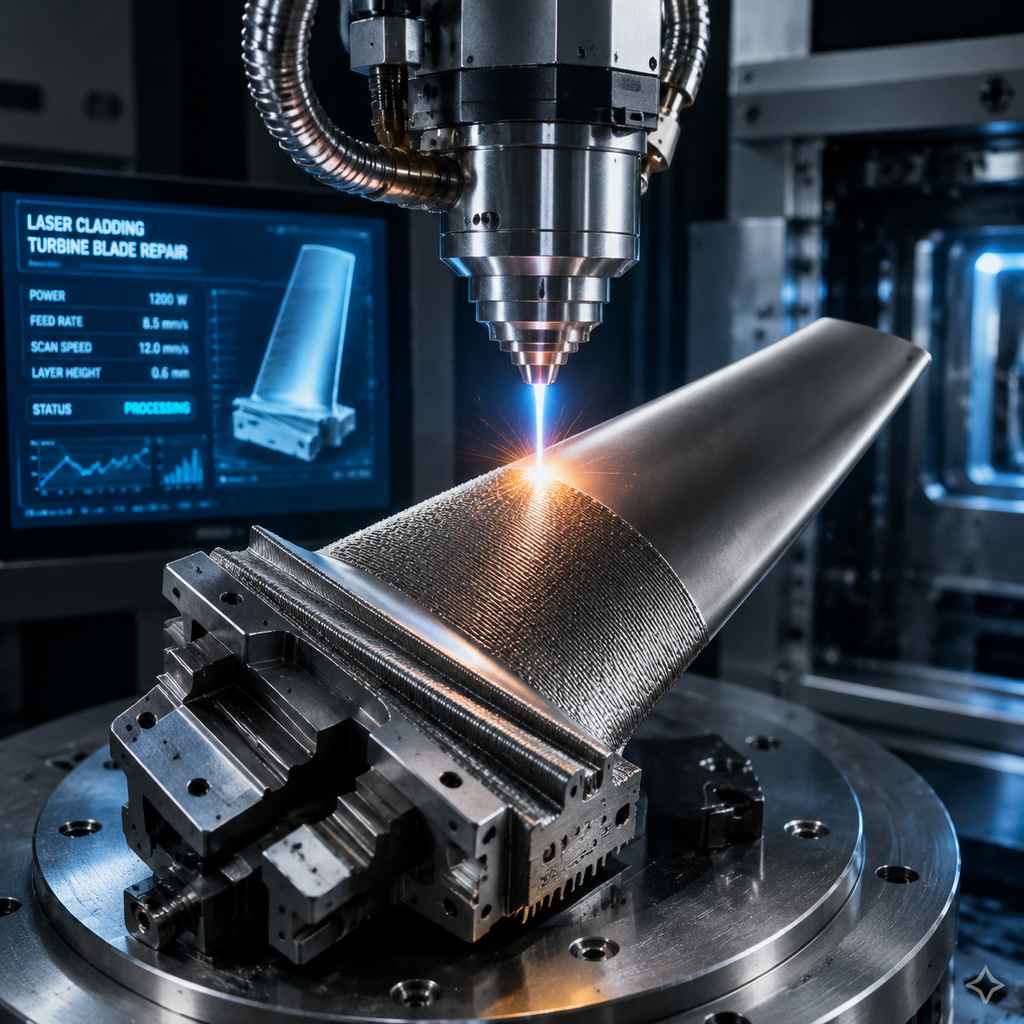
## Service challenges of aero-engine blades As the core hot-end component, aeroengine blades operate under extreme conditions of high temperature, high pressure, and high speed for a long time. Material loss occurs at the leading edge and tip of the blade due to airflow erosion and high-temperature corrosion, seriously affecting engine performance and flight safety. The traditional repair process relies on manual surfacing welding, which makes it difficult to guarantee quality stability and takes several weeks to repair, putting huge pressure on airlines in terms of downtime costs. ## The core advantages of laser cladding technology Additive manufacturing repair technology uses a laser cladding process to accurately deposit high-temperature alloy materials on the surface of damaged blades. Compared with traditional processes, laser cladding has controllable heat input and a small heat-affected zone, which can effectively avoid tissue damage to the base material. The performance of the repaired blades can be restored to more than 95% of new products, and the service life is extended several times. After an aviation maintenance company adopted this technology, the qualified rate of blade repair increased from 85% to 98%. ## Technical architecture of intelligent repair system The advanced blade repair system integrates four major modules: 3D scanning, path planning, process monitoring and quality assessment. After the high-precision laser scanner acquires the blade geometry data, the system automatically generates an optimized cladding path. The six-axis robot cooperates with the laser processing head to achieve precise repair of complex curved surfaces. The real-time monitoring system automatically adjusts the laser power and powder feeding rate through melt pool image analysis to ensure the consistency of repair quality. ## Collaborative innovation of materials and processes The research and development of blade repair materials is the key to technological breakthroughs. In response to the needs of different base materials and working conditions, materials scientists have developed a variety of high-temperature alloy powders such as nickel-based and cobalt-based. By adjusting the alloy composition and particle size distribution, the flowability and cladding performance of the material are optimized. The collaborative optimization of process parameters and material properties allows the repair layer and the substrate to form a metallurgical bond to avoid interface defects. ## Industrial application and economic value Additive manufacturing blade repair technology has been applied on a large scale in many aviation maintenance companies at home and abroad. Taking a large engine maintenance base as an example, the annual blade repair capacity exceeds 5,000 blades, the repair cost of a single piece is reduced by 40%, and the cycle is shortened by 60%. The promotion and application of this technology not only reduces the operating costs of airlines, but also provides a sustainable solution for the recycling of high-temperature alloy materials, which is in line with the development concept of green manufacturing.
Next Step Is this close to what you need?

Submit a model, drawing, image or written notes. Engineers will review material, process, finishing and delivery based on actual use.

Submit Request Ask First